
ABU DHABI, 23rd November, 2026 (WAM) -- The "Emirates of Pearls and Aromas: A Deep-Rooted Legacy, Shaping the Future" exhibition at Qasr Al Watan in Abu Dhabi is welcoming visitors to explore more than 7,000 years of UAE history through approximately 45 rare and valuable artefacts.
The exhibition highlights the significance of pearls, oud and ambergris in shaping the country's economic, social and cultural life and their enduring place in Emirati heritage and national identity.
Among its highlights is a rare maritime logbook from Ras Al Khaimah, dating to the 19th and 20th centuries, which is being displayed for the first time.
The document records trading voyages and sailors' observations, including references to Khor Fakkan and Ras Al Khaimah, offering insights into the UAE's maritime heritage and historical trade activities.
The exhibition also features natural pearls dating to the Neolithic period and the first century BCE, alongside the "Jaywan" pearl, distinguished by its perfectly round shape, purity and lustre.
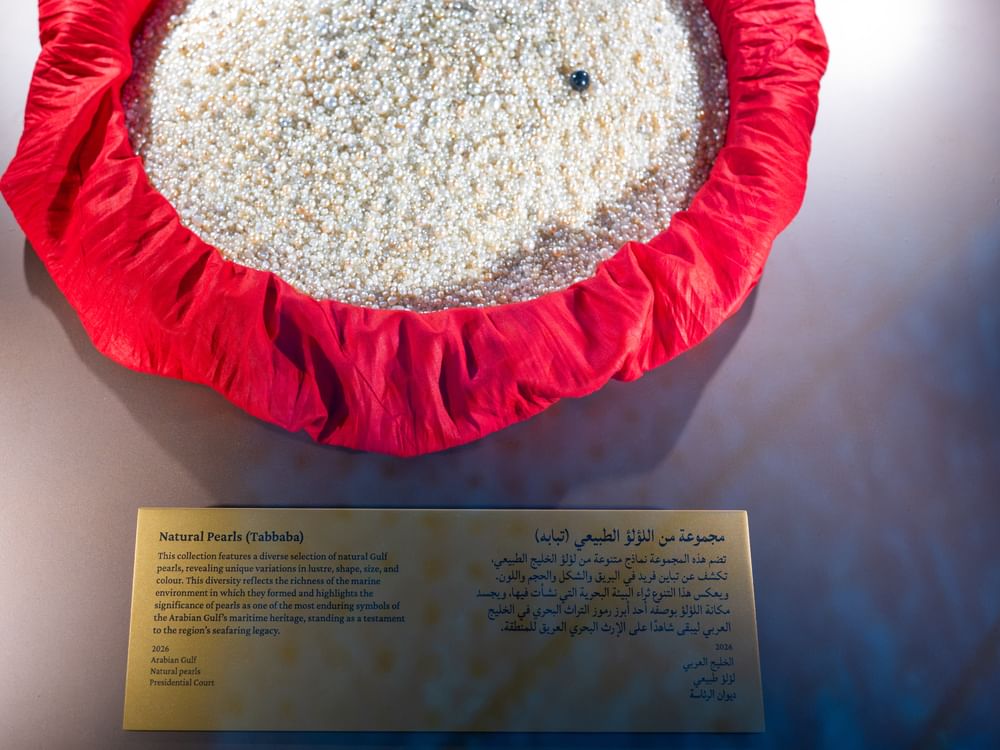
Other exhibits include a collection of natural "Al Tababah" pearls weighing approximately five kilograms and an artwork comprising 292 pearls from Ras Al Khaimah.
The collection also features a pearl necklace presented by the late Sheikh Rashid bin Saeed Al Maktoum to Pamela Codrai on the occasion of her wedding in 1952, a pendant bearing the image of the UAE's Founding Father, the late Sheikh Zayed bin Sultan Al Nahyan, and a traditional gold ornament dating to 1988.
Specimens of oud wood and natural ambergris are also on display, including a piece of ambergris weighing 28 kilograms.
The exhibition is organised into three main sections, beginning with "Ancient Trade Routes: Pearls, Oud and Ambergris as Bridges to the World".
This section explores the UAE's historical position on trade routes connecting East and West, highlighting the role of its coastline and ports in facilitating commercial and cultural exchange.
It also introduces visitors to pearl-diving seasons, maritime occupations, shipbuilding, diving equipment and the practices associated with sorting, valuing and trading pearls.
The second section, "Nature: Treasures and Stories", examines how pearls, oud and ambergris form naturally, their economic and cultural significance, and their connection to Emirati customs and traditions, particularly hospitality, generosity and welcoming guests.
The third section, "Pearls as a Historic Driver of Today's Emirates", traces the country's economic transformation from reliance on pearling and maritime trade to a modern economy driven by innovation, technology and sustainability.
It also highlights the relationship between the UAE's historical heritage and its future development ambitions.
The exhibition offers interactive and sensory experiences incorporating films, maps, archival photographs and sound effects, alongside devices that allow visitors to experience the scents of oud and ambergris.
Three contemporary artworks further connect Emirati heritage with modern artistic expression.
"Winds of Tradition", inspired by the sails of traditional vessels, evokes the movement of merchant ships across the Arabian Gulf.
"Strings of Memory" features a necklace crafted from natural pearls recovered by divers, while "Identity" brings together Gulf pearls, oud, incense and ambergris.
The exhibition forms part of Qasr Al Watan's role in showcasing the UAE's cultural and civilisational heritage, introducing younger generations to the country's traditions and strengthening cultural dialogue between peoples.