
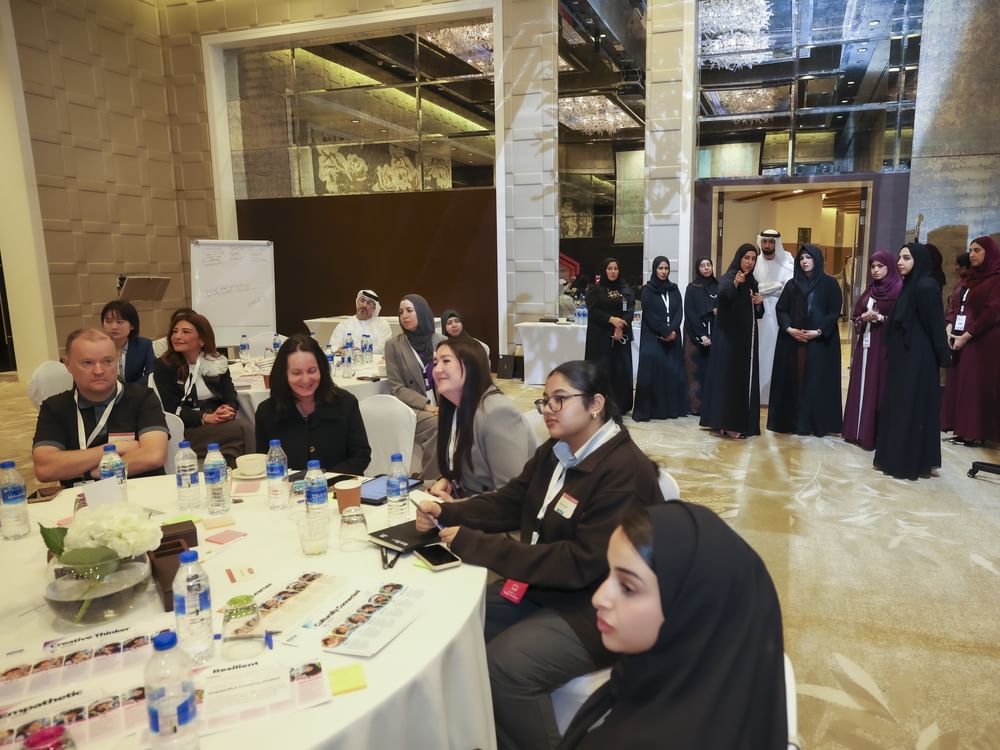
DUBAI, 24th November, 2026 (WAM) -- H.H. Sheikha Latifa bint Mohammed bin Rashid Al Maktoum, Chairperson of Dubai Culture and Arts Authority, attended the third edition of E33 CoLabs, organised by Dubai’s Knowledge and Human Development Authority (KHDA) to strengthen community participation in shaping the future of education in the emirate.
Also in attendance were Abdulla Mohammed Al Basti, Secretary-General of The Executive Council of Dubai; Hajer Ahmed Al Thehli, Secretary-General of the Education, Human Development and Community Development Council; and Aisha Abdulla Miran, Director-General of KHDA.
The event brought together around 300 teachers, students, parents and education leaders to co-create educational initiatives and projects across eight strategic areas.
These initiatives and projects aim to accelerate the delivery of game changers under Dubai’s Education 33 (E33) Strategy and develop a learner-centred education system that supports the emirate’s future ambitions.
H.H. Sheikha Latifa bint Mohammed toured E33 CoLabs 2026 and was briefed on the working sessions and interactive discussions.
She explored participants’ ideas and proposals for innovative educational initiatives and projects that address the education community’s needs and support Dubai’s efforts to build a leading, sustainable education system.
E33 CoLabs brought together participants representing all stages of Dubai’s private education system, from early childhood to higher education and beyond graduation.
Through interactive sessions and collaborative workshops, they explored future challenges and opportunities and developed practical solutions and prototypes that meet learners’ needs and improve the quality of their educational experiences and outcomes.
The E33 CoLabs series reflects KHDA’s collaborative approach to involving the education community in developing policies, designing initiatives and shaping education programmes. It ensures that development priorities draw on educational experiences and learners’ needs and aspirations, turning ideas and recommendations into practical projects with lasting impact.
Speaking at the opening session, Dr. Abdulrahman Nassir, CEO of the Business Support Sector at KHDA, said, “E33 is a shared ambition, and its success depends on the collective efforts of everyone who shapes, delivers and experiences education in Dubai. As we move forward with its implementation, the education community remains an essential partner in translating our vision into meaningful action. E33 CoLabs provides an opportunity to bring diverse perspectives together, challenge conventional thinking and develop solutions that respond to the needs and aspirations of our learners.”
He added, “We have already seen how ideas generated through the previous two editions of E33 CoLabs can lead to meaningful outcomes, from the mandatory Arabic language policy for early childhood education to the various programmes and projects currently being developed to empower all learners across Dubai’s private education sector. This is the value of co-creation: turning conversations into initiatives and ideas into action. As we continue delivering E33 together, we must remain ambitious, embrace new approaches and be willing to challenge established ways of thinking. Our ultimate measure of success is the difference we make in the lives of learners and the opportunities we create for their future.”
The third edition of E33 CoLabs featured eight themed Houses, with participants working in dedicated groups to explore eight strategic areas:
• House of Letters: Exploring mandatory Arabic language learning in early childhood education, including lessons learned and the impact achieved.
• House of 2036: Envisioning what education in Dubai could look like over the next decade.
• House of Belonging: Exploring how to identify future talent in Dubai, track its development, nurture it and encourage it to stay.
• House of Readiness: Defining the attributes and future skills learners need to be ready for the world of work.
• House of Stories: Strengthening Dubai’s position as a leading global education destination in partnership with the media.
• House of Determination: Exploring inclusive education pathways for students of determination, from admission to educational institutions through to education and training opportunities beyond the age of 18.
• House of Ambition: Improving learning outcomes for Emirati students, informed by the Programme for International Student Assessment (PISA) results and other educational evidence.
• House of Teachers: Positioning Dubai as a leading global hub for teacher professional development.
The eight Houses featured interactive sessions and group discussions, giving participants opportunities to exchange perspectives and experiences, explore future challenges and opportunities across education, and propose ideas that respond to learners’ needs and aspirations. These discussions supported the development of a more flexible, inclusive and future-ready education system.
The workshops focused on turning these ideas and proposals into innovative solutions and practical prototypes that can accelerate the delivery of E33 game changers and strengthen the education community’s role in shaping the future of education in Dubai.
This year’s edition builds on the momentum of E33 CoLabs 2025, which focused on developing initiatives and projects across seven key areas. These included designing learning pathways for Emirati students, connecting university research with entrepreneurship, enhancing teacher wellbeing and retention, and strengthening financial literacy among learners.
The previous edition also explored how to design a flexible school day that supports learner wellbeing, promote healthy digital habits among young children in early childhood education, and embed sustainability across school environments and curricula.
Since the adoption of the Education 33 Strategy in October 2024, more than 20 initiatives have been launched to shape the learner journey across all stages of education, from early childhood and school education to higher education and lifelong learning.
These initiatives span 10 key areas, including education quality, future skills development, Arabic language teaching – particularly in early childhood – national identity, inclusive education, teacher wellbeing, digital transformation, flexible regulation, and empowering students and families.
Over the past two years, 28 policies, guidelines and regulatory frameworks have also been developed, covering different stages of the learner journey in Dubai and supporting a high-quality education system with clear standards and sustainable growth.
These policies, frameworks and guidelines address nine key regulatory areas: quality and assessment; curricula; child protection and safety; inclusive education; regulation of the education workforce; school fee regulation and investment; career pathways; governance and legislation; and data and artificial intelligence.
These efforts form part of the Education 33 Strategy, which sets out a transformative vision for a learner-centred education system that responds to individuals’ needs from birth through to graduation and beyond.
The strategy supports skills development and lifelong learning, creating opportunities for learners to succeed and contribute meaningfully to society.