
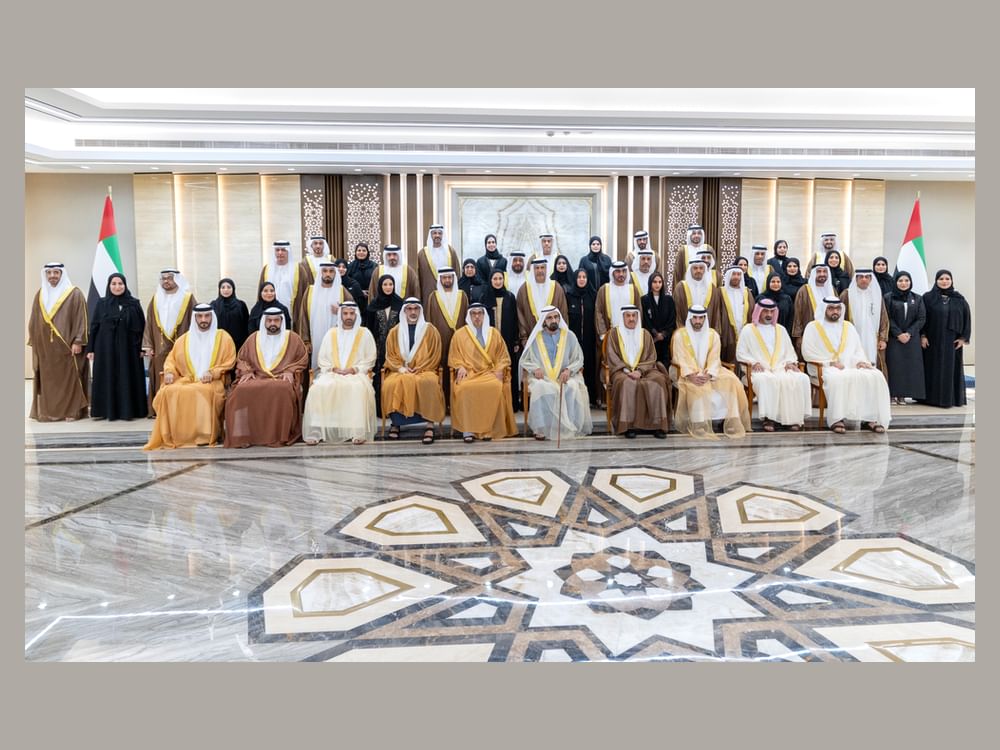
ABU DHABI, 24th November, 2026 (WAM) -- On behalf of President His Highness Sheikh Mohamed bin Zayed Al Nahyan, His Highness Sheikh Mohammed bin Rashid Al Maktoum, Vice President, Prime Minister and Ruler of Dubai, today inaugurated the fourth ordinary session of the 18th legislative term of the Federal National Council (FNC), in the presence of His Highness Sheikh Mansour bin Zayed Al Nahyan, Vice President, Deputy Prime Minister and Chairman of the Presidential Court.
The opening ceremony, attended by Crown Princes, Deputy Rulers, Their Highnesses the Sheikhs, a number of senior civilian and military officials, members of the diplomatic corps in the UAE, and FNC members, began with the UAE national anthem, followed by the recitation of verses from the Holy Quran.
His Highness Sheikh Mohammed bin Rashid Al Maktoum formally inaugurated the fourth ordinary session of the 18th legislative term, saying: "In the name of Allah, the Most Gracious, the Most Merciful. "My brothers and sisters, the Speaker and members of the Federal National Council, "With Allah's blessings and guidance, we hereby open your esteemed Council. We pray to Almighty Allah that this opening will bring goodness and blessings to the people and the nation. "Peace, mercy and blessings of Allah be upon you."
Federal Decree No. 148 of 2026, issued by President His Highness Sheikh Mohamed bin Zayed Al Nahyan, calling the Federal National Council to convene, was then read out.
Saqr Ghobash, Speaker of the Federal National Council, delivered a speech in which he welcomed His Highness Sheikh Mohammed bin Rashid Al Maktoum, His Highness Sheikh Mansour bin Zayed Al Nahyan and all attendees to the opening of the fourth session of the 18th legislative term, marking the beginning of a new phase in the Council's exercise of its constitutional and legislative responsibilities.
Ghobash said: "On this occasion, I extend my highest expressions of gratitude and appreciation to President His Highness Sheikh Mohamed bin Zayed Al Nahyan; His Highness Sheikh Mohammed bin Rashid Al Maktoum; His Highness Sheikh Mansour bin Zayed Al Nahyan; and Their Highnesses, Members of the Supreme Council and Rulers of the Emirates, for their gracious patronage and continued support throughout the sessions of this legislative term.
Their support has enabled the Council to fulfil its responsibilities and embodied the vision of our wise leadership in strengthening consultation and integration among state institutions, continuing the approach established by the late founding father, Sheikh Zayed bin Sultan Al Nahyan, and his fellow founding fathers, may their souls rest in peace."
He continued: "Since the establishment of our blessed Union, the UAE has distinguished itself through its ability to strike a balance between the strength and stability of the state and its openness while preserving its identity; between its economic ambitions and the cohesion of its society; and between safeguarding human dignity, security and quality of life, which remain the ultimate objectives of all progress.
"The distinguished position our nation has attained is the result of a far-reaching leadership vision that has made investing in people, building strong institutions and preparing for the future interconnected pillars of national strength and sustainable development."
Ghobash affirmed that, amid these significant national developments, "we stand with the utmost reverence and pride before the honourable achievements of our brave Armed Forces and the exceptional readiness, competence and capability they have demonstrated in protecting the nation's skies, territory and people, as well as embodying the deterrent strength that safeguards its sovereignty, security and stability.
"He added that the members of the Armed Forces had demonstrated that the investments made by the UAE over the years in developing its defence capabilities constitute the true guarantee of peace. They have proven themselves worthy of the trust placed in them and the immense responsibility entrusted to them. We therefore extend our highest respect and appreciation to their leadership, officers and personnel for their dedication and for exemplifying the honour of duty and the nobility of their allegiance to the nation."
He further explained: "This phase has demonstrated the strength of the national system and the integration of its various roles, from our brave Armed Forces, security agencies and national institutions, which have fulfilled their duties with efficiency and distinction, to the national media, which has strengthened public awareness, and a society whose cohesion and confidence in its leadership have grown stronger.
"Citizens and residents stood united, shoulder to shoulder, behind the state. The deeper lesson of this experience is that the strength of nations is not built when crises arise; rather, it is developed over many years through planning and investment in people, institutions, preparedness and international partnerships.
"What we witnessed was not merely a success, but a reaffirmation of the soundness of our national approach: preparing for the future is, at its core, one of the most important ways to protect the nation and preserve its achievements."
Ghobash affirmed that, guided by this national vision, the Federal National Council derives its responsibility to contribute to strengthening the state and safeguarding its interests.
He noted that the Council had continued to leverage its relationships with parliaments and international parliamentary organisations to convey the UAE's positions to representatives of people around the world, explain the challenges it had faced, affirm its right to protect its security and sovereignty, and reinforce the fact that the security of the UAE and the Gulf is an integral part of international security.
These efforts complement the UAE's foreign policy. Domestically, the Council has also continued to fulfil its legislative and oversight responsibilities in cooperation with the government, recognising that the value of parliamentary work lies in its impact on the quality of decision-making, the effectiveness of oversight, the efficiency of public policies, and their ability to meet society's needs and keep pace with the future.