
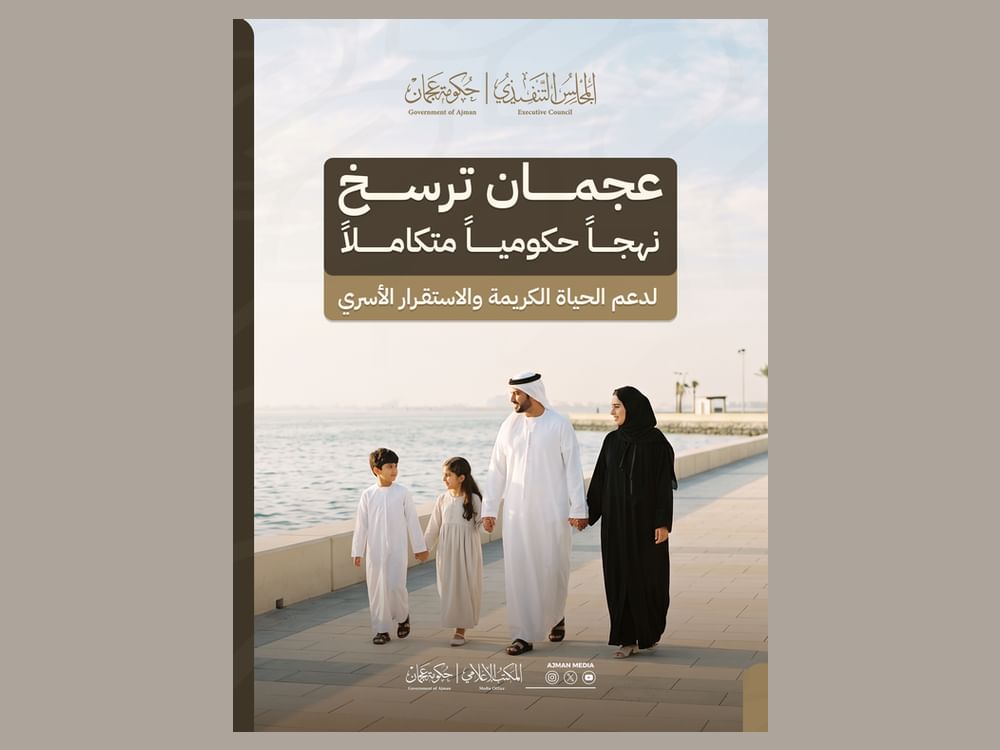
AJMAN, 26th November, 2026 (WAM) -- Ajman Government has adopted the Conceptual Reference for Dignified Living and Family Stability, establishing a shared government framework to assess the needs of Emirati families and coordinate policies, services and interventions to improve their quality of life, stability, cohesion and resilience.
Approved by the Ajman Executive Council during its meeting held as part of the UAE Government Annual Meetings 2026, the framework aligns with the national priorities of the Year of the Family 2026, the National Family Growth Agenda 2031 and the objectives of Ajman Vision 2030.
The framework marks a shift from addressing family needs through separate programmes and services to treating the family as an integrated unit whose circumstances and needs evolve over time. It strengthens coordination across social support, housing, health, education, employment, care and community services to achieve shared outcomes.
The reference identifies four principal dimensions for understanding family circumstances: fulfilment of basic needs, living stability, family resilience, and family cohesion and capacity. These extend beyond income levels and immediate needs to encompass families’ ability to maintain their standard of living, respond to unforeseen circumstances, fulfil their roles and preserve their cohesion.
It also adopts the concept of a reference budget as a tool for understanding a family’s living needs, taking into account its specific circumstances, composition, number of members, housing and care requirements, and changes in living costs. This is founded on the principle that dignified living cannot be reduced to a single financial benchmark applicable to all families.
The reference reinforces a proactive approach to challenges that families may face through the early identification of pressures affecting their stability and the direction of government interventions along five principal pathways: prevention, protection, stability, empowerment and urgent response.
These pathways seek to empower families capable of achieving stability through their own resources while providing protection to those with limited capacity to improve their circumstances, based on their individual needs.
The reference highlights safe transition as a key foundation for sustained family stability. It establishes the principle of adjusting support gradually when a family’s income or circumstances improve, while considering the combined impact of the support and benefits it receives from different entities. This ensures that an improvement in the family’s circumstances does not result in a decline in its standard of living.
The reference is founded on nine guiding principles: dignity, empowerment, privacy and confidentiality, fairness, proportionality, prevention, integration, sustainability, and accountability for outcomes.
These principles recognise families as partners in achieving their own stability and focus government efforts on measuring tangible and sustainable improvements in their lives, rather than relying solely on expenditure, beneficiary numbers and services provided.
The reference provides a shared conceptual foundation for developing family-related policies, programmes and implementation tools, while preserving government entities’ mandates and approved eligibility requirements. This supports the consistency and integration of government efforts.
It reflects Ajman Government’s commitment to building an inclusive, cohesive and empowered society, strengthening social services and placing people’s quality of life at the heart of its development priorities.